
A couple months ago, I read Kelly Barnhill’s essay about recovering from a traumatic brain injury, and relearning narrative structure, in the New York Times Opinion section. I’m not familiar with her fiction—though a copy of her The Girl Who Drank the Moon has been in my TBR pile for a while, passed along by my mom—but something in Barnhill’s NYT piece caught my attention, and hasn’t let it go.
That something is what I have come to call, in recent weeks, a “story equation.” Equation because there’s a mathematical element to it—it can be written out in a line, using mathematical symbols, and it creates basic structure in its implicit nod toward linear time.
Here’s her to-the-point story equation (which you can see scribbled on an index card in the essay):
STORY = (character + place) change / time.
When I saw it, I thought YES! I wrote it down in one of my many notebooks.
I like the simplicity of it. I like what it captures. The analytical part of me, the part that prefers algebra to geometry, loves this equation and wants to submit to it fully.
But (you were waiting for the but, weren’t you?), I kept coming back to the line and feeling dismayed. Telling a linear story is, I suppose—often, and/or in theory, and/or for some people—this easy.
While it is possible for me to tell a linear story,1 much of what happens inside my brain before getting to that story, and while writing that story, is not linear at all. I struggled with this for a long time. I STILL struggle with it, almost every single time I sit down to write something new with a beginning, middle, and end (which is to say, often).
It is, I am aware, practical to understand story in this stripped-down way. But the urge to tell stories, however instinctual, doesn’t strike me as particularly practical at all.
Eventually I tired of arguing with Barnhill’s (in and of itself reasonable) story equation and decided to write my own.
What if, story =
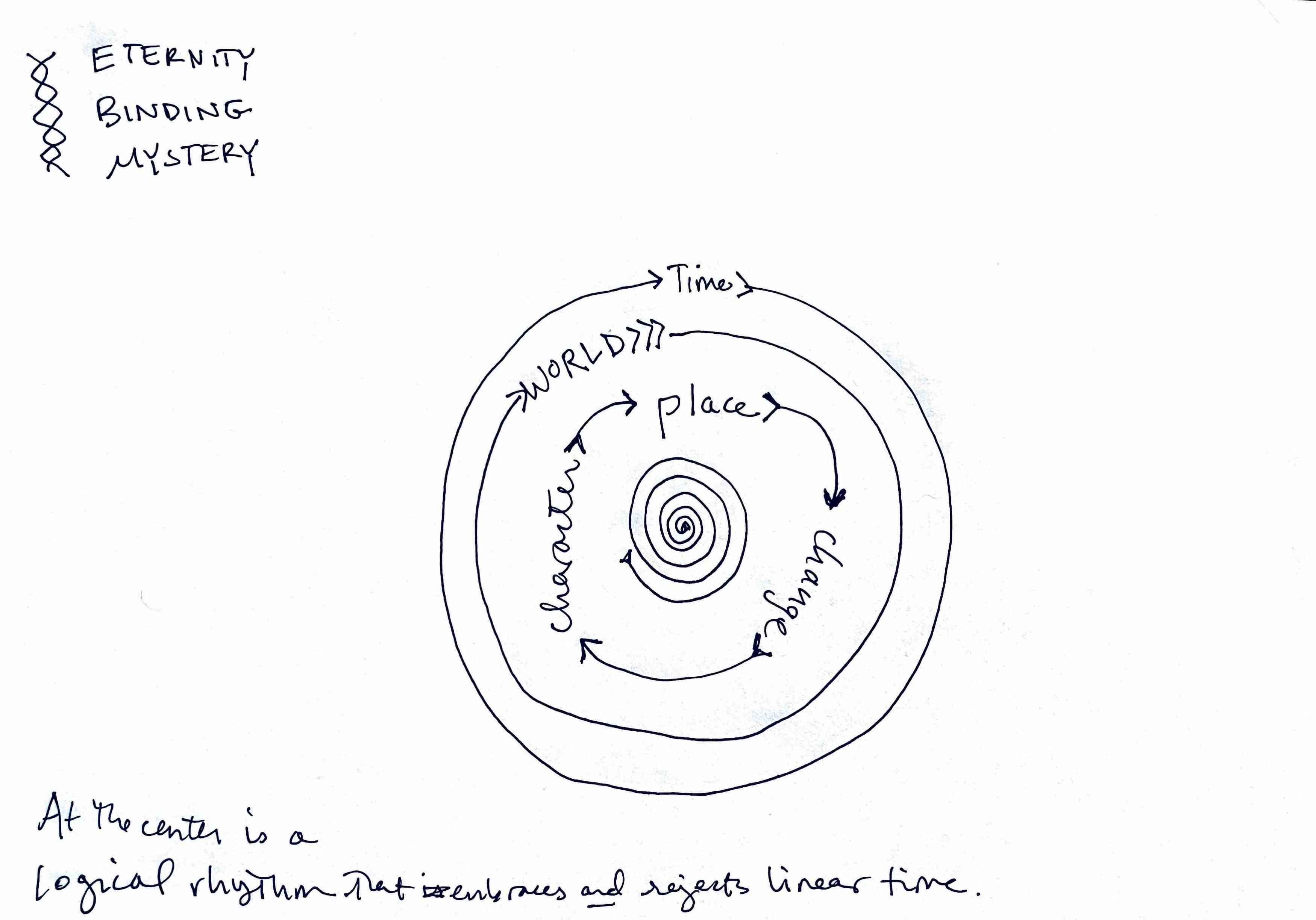
What I produced isn’t exactly an equation. It’s a—space. An area to inhabit where the elements of story are moving. There’s still a sense of linearity, since a circle is a bent line, with one thing leading to another leading to another leading to another.
I was tempted to make the arrows connecting character, place, and change move in both directions, but ultimately decided that felt too cluttered. While memory allows us to look back to create meaning, we can only live life moving forward.2 And as the circle turns, the impact of character on place on change on character on place on change grows inseparable. These elements require one another for the movement necessary to their very beingness. Take one out and the shape, the essence, the subtle body, collapses.
There are plenty of books and writers out there whose concept of story might resemble mine. (Maggie Nelson’s Bluets comes easily to mind, as does Sandra Gail Lambert’s The River’s Memory, Hilary Plum’s They Dragged Them through the Streets, Marlon James’s Moon Witch, Spider King (which I’m slowly making my way through right now), Quintan Ana Wikswo’s brilliant A Long Curving Scar Where the Heart Should Be, and lots of contemporary literature in translation.) I remind myself once again: there’s no right or wrong way to do this story thing.
There’s no reason to prioritize a story equation over a story space or vice versa. As a writer you may lean one way or another (or in some other direction entirely—this is a multidimensional space!), and your leaning might change from project to project. Over the long years of learning (and unlearning) how to write, I’ve settled into a philosophy of craft most closely aligned with what Italo Calvino calls “a system of systems” in his essay “Multiplicity.” Though it can be, at times, overwhelming, his idea that fiction holds “infinite simultaneous universes in which all possibilities are realized in all their possible combinations” brings me a lot of solace. It’s a gorgeous, messy place to hang out. And there’s room for everything: algebraic story equations and geometric story spaces alike.
We had some snow earlier this week, and while taking pictures of the kids making snow angels, I accidentally captured an accurate image of my psyche come January—
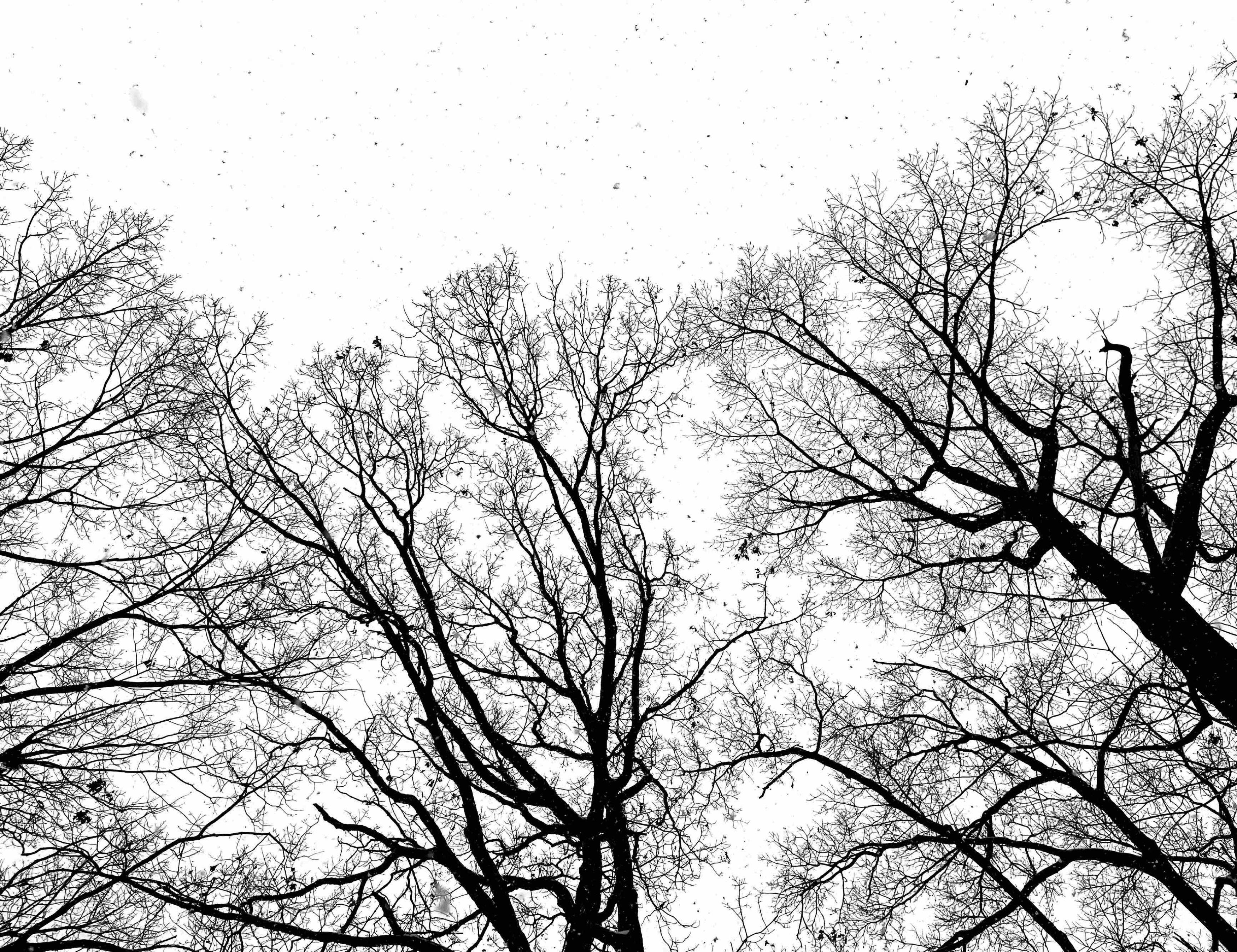
(Maybe I’ll riff on fractals in a different post, as they’re a favorite of mine. But for now, I’ll leave you with a link to a poem of winter hope, which lightened my day a bit when I read it. May it do the same for you.)
- Before I go any further, I suppose I’ll say: NOT EVERY STORY MUST BE LINEAR. To be extra clear, I’m all for trusting a story’s inate wisdom, linear or otherwise, when it comes to structure. But for the purposes of this post, I’m thinking about stories that are roughly linear, and maybe especially those that pretend not to be. ↩︎
- I’m paraphrasing Kierkegaard here: “It is really true what philosophy tells us, that life must be understood backwards. But with this, one forgets the second proposition, that it must be lived forwards.” ↩︎